
When people hear the terms modern architecture and contemporary architecture, it is easy to assume they mean the same thing. After all, both are often associated with clean lines, simple forms, large windows, open spaces, and a departure from traditional architectural styles.
But there is an important difference.
Modern architecture refers to a particular architectural movement and period, while contemporary architecture refers to architecture being designed and built today.
The confusion mostly comes from everyday language. We often use the word “modern” to mean “new” or “up-to-date.” In architecture, however, Modern Architecture has a much more specific historical meaning.
Understanding the difference between modern and contemporary architecture makes it easier to recognize architectural styles, understand their history, and appreciate why different buildings look and feel the way they do.
What Is Modern Architecture?
Modern architecture is an architectural movement that developed primarily during the late 19th and early 20th centuries and became especially influential during the 20th century.
It emerged partly as a response to traditional architectural styles that relied heavily on historical references, ornamentation, and established decorative traditions.
Modern architects began looking for new ways to design buildings that reflected the changing world around them.
Industrialization had introduced new materials, construction techniques, transportation systems, machines, and manufacturing processes. Concrete, steel, and large sheets of glass made it possible to construct buildings that would have been difficult or impossible using traditional methods.
Instead of decorating buildings with historical details, Modernist architects often emphasized the structure, function, materials, and geometry of the building itself.
The result was an architectural language characterized by simplicity, clarity, and a strong interest in functionality.
Some of the ideas commonly associated with Modern Architecture include:
- Clean geometric forms
- Simple compositions
- Flat or low-pitched roofs
- Large windows
- Open floor plans
- Minimal ornamentation
- Exposed or clearly expressed structure
- Industrial materials
- Functional planning
- Strong horizontal and vertical lines
Modern Architecture was not a single style. It included many different approaches and architects, but they shared a broader interest in creating architecture appropriate to the modern age.
What Is Contemporary Architecture?
Contemporary architecture refers to architecture of the present day.
The word “contemporary” essentially means “existing or occurring at the same time.” In architecture, contemporary design describes buildings being designed and constructed in the current period.
Unlike Modern Architecture, contemporary architecture is not necessarily tied to one historical movement or a single visual style.
Instead, contemporary architects can draw from many influences.
A contemporary building might have minimalist forms, sustainable materials, organic shapes, advanced technology, exposed structure, traditional materials, or a combination of several approaches.
Contemporary architecture is often influenced by current technology, environmental concerns, new construction methods, changing lifestyles, and evolving ideas about how people should use buildings.
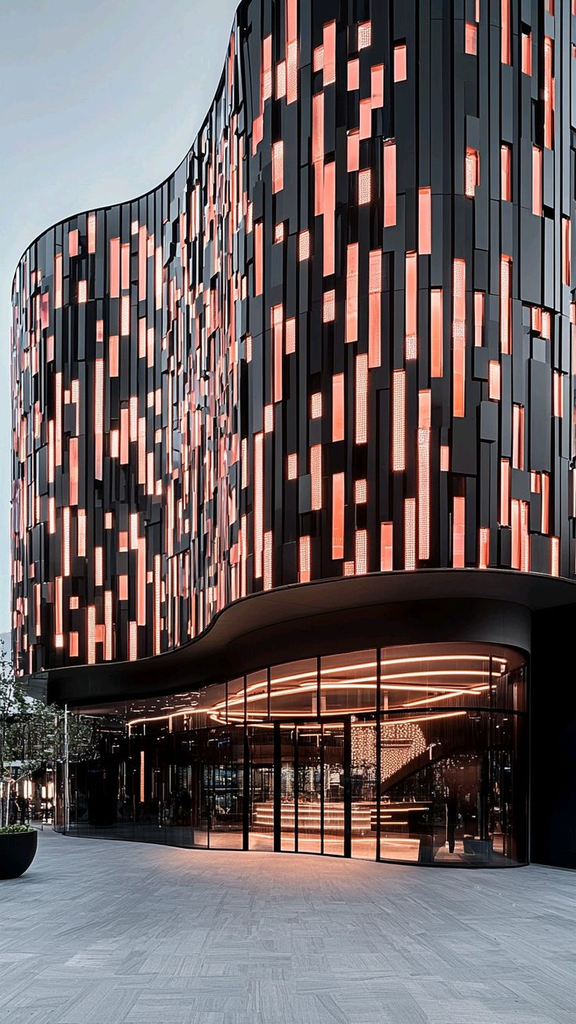
Some contemporary buildings are highly geometric and minimalist. Others have curved forms that would have been extremely difficult to construct in earlier periods.
You may see:
- Complex geometric shapes
- Curved walls
- Large areas of glass
- Sustainable materials
- Green roofs
- Solar panels
- Smart building systems
- Innovative structural systems
- Mixed materials
- Open and flexible interiors
- Digital fabrication
- Strong connections between indoor and outdoor spaces
This variety is one of the defining characteristics of contemporary architecture.
Modern vs Contemporary Architecture: The Main Difference
The simplest way to understand the distinction is this:
Modern Architecture is a historical architectural movement. Contemporary Architecture is architecture of the present time.
Modern Architecture developed during a particular historical period and was associated with a collection of ideas about how architecture should respond to modern society.
Contemporary Architecture does not belong to one specific historical movement. It describes what architects are designing now, and therefore it can continue to change as technology, culture, environmental priorities, and lifestyles change.
Think of it this way:
Modern = a historical movement.
Contemporary = current architecture.
This distinction is important because a building constructed today can be modern in appearance without necessarily being an example of Modern Architecture.
Modern Architecture and Its Historical Roots
To understand Modern Architecture, it helps to look at the conditions that produced it.
During the late 19th and early 20th centuries, society was changing rapidly.
Factories were expanding, cities were growing, new transportation systems were being developed, and industrial production was changing everyday life.
Architecture also began to change.
New structural technologies allowed architects to experiment with building forms and spaces.
Steel structures could support large buildings. Reinforced concrete allowed for new structural possibilities. Glass could be used to create larger openings and more visually open interiors.
Architects began questioning whether buildings should continue copying historical styles when society itself had changed so dramatically.
This led to a broader movement toward architectural experimentation.
Important Figures in Modern Architecture
Several architects became strongly associated with the development and spread of Modern Architecture.
Le Corbusier promoted ideas about functional planning, simple geometric forms, and architecture suited to modern living.
Ludwig Mies van der Rohe became associated with minimalist compositions, structural clarity, steel and glass construction, and the idea that architectural design could be reduced to essential elements.
Walter Gropius played an important role in the development of the Bauhaus and promoted relationships between architecture, design, technology, and craftsmanship.
Frank Lloyd Wright developed an architectural philosophy that emphasized relationships between buildings, people, materials, and their surrounding environments.
These architects did not all design buildings in exactly the same way. Their work demonstrates that Modern Architecture was a broad movement containing different ideas and interpretations.
The Role of Function in Modern Architecture
One of the most recognizable ideas associated with Modern Architecture is the importance of function.
Modernist architects often questioned unnecessary decoration and focused instead on how buildings could serve their users.
This led to an increased interest in:
- Efficient floor plans
- Functional circulation
- Natural lighting
- Ventilation
- Flexible interiors
- Structural logic
- Appropriate materials
The famous phrase “form follows function” is often associated with discussions of modern architectural thinking, although its history and interpretation are more complicated than the phrase suggests.
The broader idea is that the purpose of a building should have an important influence on its design.
The Role of Technology
Technology plays a major role in both modern and contemporary architecture, but the technologies available to contemporary architects are vastly different from those available to early Modernists.
Modern architects were experimenting with industrial materials such as steel, reinforced concrete, and large expanses of glass.
Contemporary architects have access to digital modeling, advanced structural analysis, computer-controlled fabrication, high-performance materials, smart building systems, and sophisticated environmental technologies.
Computer-aided design has also changed the possibilities for architectural form.
Architects can now develop and analyze complex shapes before construction begins. Digital fabrication can allow components to be manufactured with extremely precise geometries.
This does not mean contemporary architecture must look futuristic. Technology can be used subtly to improve performance, comfort, efficiency, and construction.
Sustainability and Contemporary Architecture
One of the biggest differences between much historical Modern Architecture and contemporary architectural practice is the increasing importance of environmental sustainability.
Contemporary architects often consider how buildings affect energy consumption, natural resources, carbon emissions, water use, waste, and the surrounding environment.
Sustainable design strategies can include:
- Passive solar design
- Natural ventilation
- Solar energy
- Rainwater collection
- Green roofs
- Energy-efficient glazing
- High-performance insulation
- Recycled or locally sourced materials
- Daylighting
- Water-efficient systems
Sustainability is not a single architectural style. A sustainable building can have a minimalist appearance, a traditional appearance, or something completely different.
This demonstrates an important feature of contemporary architecture: performance and environmental responsibility can influence architectural form without defining one specific visual style.
Visual Differences Between Modern and Contemporary Architecture
There can be significant visual overlap between the two.
A contemporary building may use the clean lines and simple geometry associated with Modern Architecture.
However, contemporary buildings may also explore forms that would not typically be associated with traditional Modernism.
Modern Architecture often favors:
- Rectangular forms
- Geometric simplicity
- Horizontal and vertical lines
- Flat roofs
- Minimal ornament
- Steel, concrete, and glass
- Open plans
Contemporary Architecture may include all of these features but can also incorporate:
- Curved forms
- Irregular geometries
- Sculptural shapes
- Mixed materials
- Complex façades
- Dynamic structures
- Responsive building systems
- Environmentally driven forms
Therefore, appearance alone cannot always tell you whether a building is modern or contemporary.
Modern and Contemporary Interior Spaces
The difference can also be seen indoors.
Modern interiors often emphasize simplicity, open space, functional furniture, and minimal decoration.
Materials such as wood, leather, concrete, steel, and glass may be used in restrained ways.
Contemporary interiors can also be minimalist, but they are often more flexible in terms of materials, textures, colors, and forms.
A contemporary interior might combine natural wood with exposed concrete, sculptural lighting, curved furniture, recycled materials, and smart technology.
The important distinction is not that modern interiors are simple while contemporary interiors are complex.
Instead, the difference is primarily historical and conceptual.
Is Modern Architecture the Same as Minimalist Architecture?
No.
This is another common misunderstanding.
Modern Architecture often uses minimalist principles, but Modern Architecture and minimalism are not identical.
Minimalism is a broader design approach that emphasizes reduction, simplicity, essential forms, and the removal of unnecessary elements.
A contemporary building can be minimalist.
A modern building can also be minimalist.
But the two terms describe different things.
One describes a historical architectural movement, while the other describes an approach to design.
Is Contemporary Architecture Always Futuristic?
Not at all.
Contemporary architecture is sometimes imagined as buildings covered in glass with dramatic curves and unusual shapes.
While such buildings certainly exist, contemporary architecture is much broader.
A contemporary building can be simple, modest, traditional-looking, highly sustainable, experimental, or even inspired by local architectural traditions.
What makes it contemporary is primarily its relationship to the current period and current architectural thinking.
An architect today might reinterpret traditional materials or regional building techniques using modern construction technology.
That can still be contemporary architecture.
Why the Difference Matters
Knowing the difference between modern and contemporary architecture helps us understand architectural history more accurately.
If someone describes a building as “modern” simply because it looks new, they may be using the everyday meaning of the word.
But in architectural discussions, “Modern Architecture” generally refers to a particular movement.
This distinction becomes especially important when studying architectural history.
For example, a building constructed in 1930 might be an example of Modern Architecture even though it is obviously not contemporary.
Meanwhile, a building completed in 2026 could be contemporary architecture even if it borrows visual ideas from traditional or historic styles.
The date of construction, design philosophy, historical context, and architectural approach all matter.
A Simple Comparison
| Feature | Modern Architecture | Contemporary Architecture |
|---|---|---|
| Meaning | Historical architectural movement | Architecture of the present period |
| Main period | Primarily 20th century | Current era |
| Ornament | Generally minimized | May be minimal or expressive |
| Forms | Often simple and geometric | Can range from simple to highly complex |
| Materials | Steel, concrete, glass, wood | Traditional and advanced materials |
| Technology | Industrial-era technologies | Digital and advanced technologies |
| Sustainability | Not always a central concern | Often an important design consideration |
| Style | Associated with Modernism | No single defined style |
| Flexibility | Often emphasized | Frequently emphasized |
| Relationship to history | Often rejected historical imitation | May reinterpret or combine historical influences |
Can a Building Be Both Modern and Contemporary?
This is where the terminology can become confusing.
A contemporary building can be modern in appearance without being part of the historical Modern Movement.
For example, an architect today might design a simple concrete-and-glass house with an open floor plan and minimal decoration. Visually, it might resemble a Modernist building from the mid-20th century.
Because it was designed today, however, it is contemporary architecture.
At the same time, architects sometimes deliberately revive Modernist principles in contemporary projects. In that situation, a contemporary building can clearly be influenced by Modern Architecture.
So the two categories can overlap in appearance and influence even though their meanings are different.
Modern Architecture vs Contemporary Architecture: Which One Is More Minimal?
It is tempting to say that Modern Architecture is more minimalist and contemporary architecture is more experimental, but that would be an oversimplification.
There are extremely minimalist contemporary buildings and highly expressive examples of Modern Architecture.
The better distinction is historical.
Modern Architecture emerged as a movement with particular ideas about architecture, technology, society, structure, and ornament.
Contemporary architecture represents the diverse approaches being explored today.
This means contemporary architecture can include minimalism, high-tech design, sustainable architecture, organic architecture, regional influences, adaptive reuse, and many other approaches.
The Evolution From Modern to Contemporary
Architecture did not suddenly stop being modern and become contemporary.
Architectural ideas evolved gradually.
Modernism influenced later generations of architects. Some embraced its principles, while others criticized or challenged them.
Postmodern architecture, high-tech architecture, deconstructivism, regional approaches, sustainable design, and other movements contributed to the architectural landscape that exists today.
Contemporary architecture is therefore better understood as part of an ongoing conversation rather than a completely separate style.
Architects continue to ask questions that earlier generations asked:
How should buildings respond to society?
How should technology influence design?
What should a building look like?
How much decoration is necessary?
How should architecture respond to climate?
How can buildings be more adaptable?
How should architecture relate to history and culture?
The answers continue to change.