
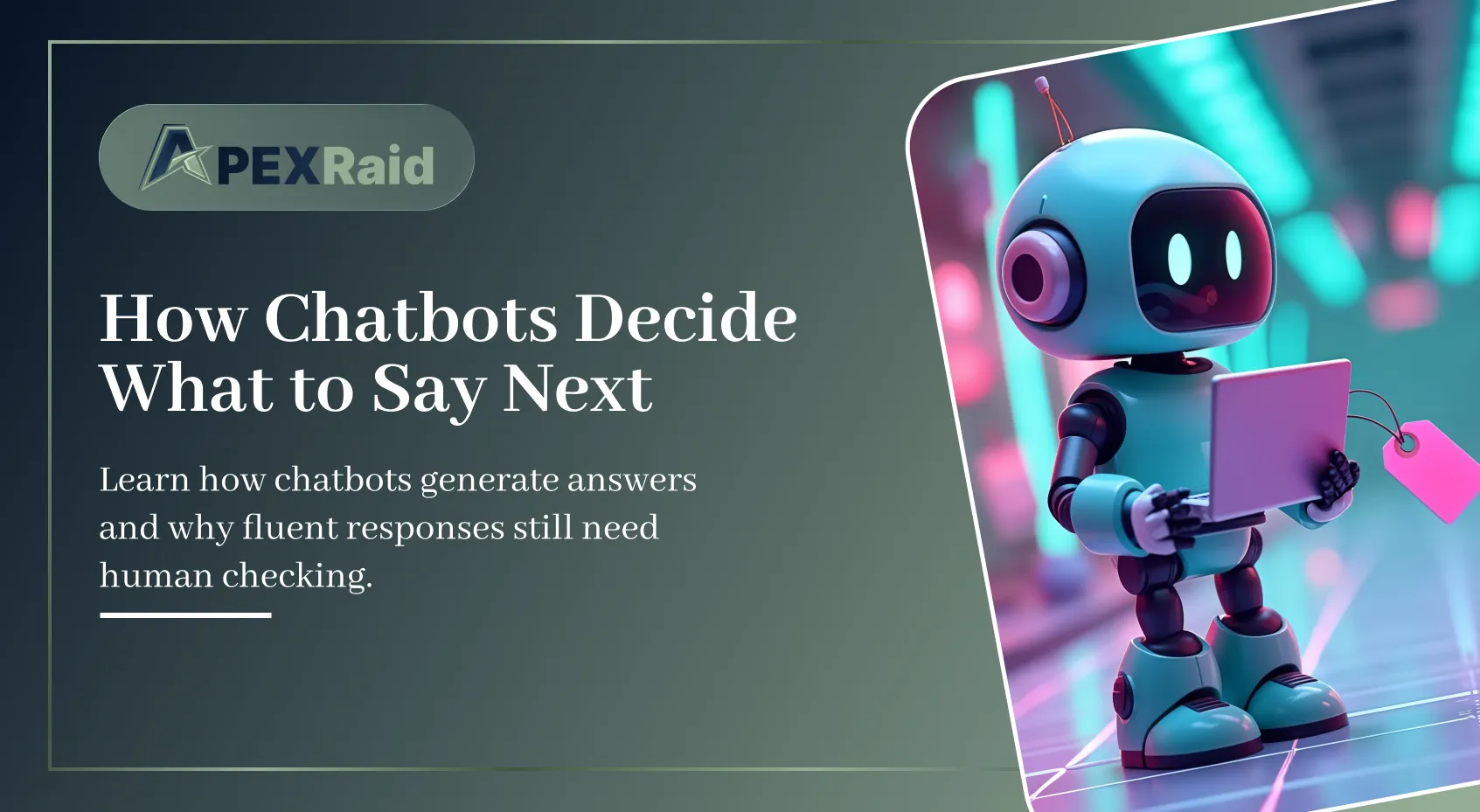
When a chatbot answers instantly, it can feel like it understands you. But the process is more mechanical than magical. Chatbots do not sit there reasoning like a person. They generate language by predicting what comes next based on patterns they learned from training data.
That is why the same chatbot can sound polished one moment and strangely off the next. It is not reading your mind. It is matching patterns, weighing likely responses, and choosing the next piece of text that fits the conversation.
The basic idea
Most modern chatbots are trained on huge collections of text. During training, they learn which words and phrases often appear together. When you ask a question, the model uses that pattern knowledge to predict a useful response token by token.
Think of it like an extremely advanced autocomplete system. It is much more sophisticated than your phone keyboard, but the core idea is similar. The model is not looking up a perfect answer from a hidden database. It is generating the most likely answer based on the conversation it has seen and the context you gave it.
Why answers can sound confident
Chatbots are designed to be fluent. That fluency is part of what makes them helpful, but it can also be misleading. A response can sound persuasive even when it is incomplete, outdated, or just plain wrong. The smooth tone is not proof of accuracy.
That is one of the most important habits for users to learn: do not confuse confidence with correctness. A chatbot can speak in a calm, polished way and still miss the point completely if the prompt is vague or the topic is outside its best knowledge.
Why context matters
Chatbots pay attention to the words around your question. If your prompt is vague, the answer may drift. If your prompt is specific, the result is usually better. In other words, the quality of the output depends heavily on the quality of the input.
This is why people who use AI well often spend time refining their prompt, adding context, and asking follow-up questions. A good prompt gives the model a better path to follow, which usually means a better answer.
What happens behind the scenes
Under the hood, a chatbot is balancing many possible next words at once. It chooses the sequence that best fits your message and the instructions it has been given. Some systems also use tools, search, or extra retrieval steps to ground the answer in current information. When those tools are not available, the response depends more heavily on learned patterns alone.
That is why different chatbots can feel different even when they are answering similar questions. Their training, safety rules, and tool access all shape the final reply.
What makes them useful
Even with limitations, chatbots are valuable because they can help brainstorm, summarize, translate, draft, explain, and organize ideas very quickly. They are especially useful when you already know enough to judge whether the output makes sense.
People often get the best results when they use chatbots as a draft partner or a thinking aid instead of treating them as an unquestionable source of truth.
A practical rule for users
If the chatbot gives you something important, slow down and verify it. Ask for sources. Compare it with trusted references. Check whether the answer makes sense in the real world. That habit is more valuable than any fancy prompt trick.
Key takeaway
Chatbots decide what to say next by predicting language patterns from training data and current context. They can be very helpful, but their fluent tone should never replace careful review.
Once you understand that basic mechanism, it becomes much easier to use them well. You can appreciate what they do, avoid expecting too much from them, and keep your own judgment in the loop.