
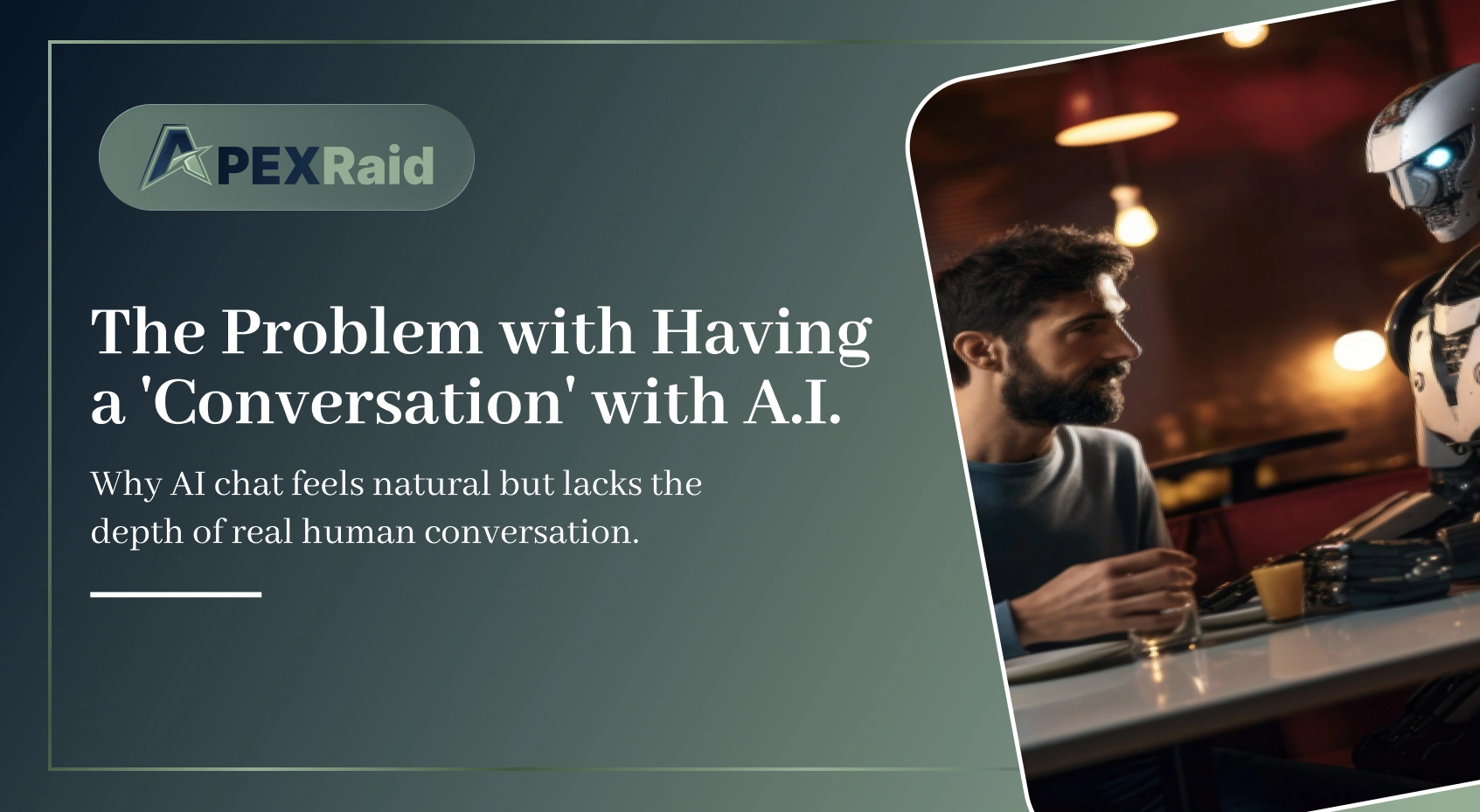
Chatting with AI feels easy in a way that old software never did. You type a question, get a quick reply, and the back-and-forth feels almost like talking to another person. That friendliness is part of the appeal. It is also the reason we should be careful. Alan Turing's 1950 paper on the Imitation Game anticipated this phenomenon: when a machine can produce responses indistinguishable from a human's, we naturally treat it as a thinking being. The ease of interaction is a testament to decades of advances in natural language processing, but it also creates a dangerous illusion of understanding.
When a machine uses natural language, people instinctively start giving it human qualities. We assume it understands us. We assume it cares. We assume the conversation means more than it actually does. But the experience is smoother than the reality underneath it. That gap matters because smooth interaction can hide limits. A good interface can make a tool feel smarter, kinder, and more reliable than it really is.
This guide provides a comprehensive, evidence-based examination of why AI conversations feel so natural, the psychological mechanisms behind this perception, and why maintaining critical judgment is essential.
Why it feels personal
Humans are built to notice voices, tone, and patterns of response. If something answers in a calm, helpful way, we tend to treat it as socially meaningful. That is why a chatbot can feel surprisingly warm even when it is only assembling likely responses from patterns it has seen before. The response may be useful, but usefulness is not the same as understanding. The machine can sound attentive without actually being attentive.
That does not mean people are silly for reacting that way. It just means the design is doing its job well enough to trigger a very human response. A lot of that response happens before we even notice it. The tool sounds patient, the replies come quickly, and suddenly we are treating it as if it were a small conversational partner instead of a very advanced text system.
Research on anthropomorphism has found that humans attribute human-like qualities to machines when they exhibit three characteristics: the ability to communicate in natural language, the appearance of autonomy, and the display of socially appropriate behaviour. AI chatbots meet all three criteria, making anthropomorphism almost inevitable. This is not a design flaw — it is a consequence of how human cognition works.
The Eliza Effect and the Power of Linguistic Mimicry
One of the earliest and most important demonstrations of this phenomenon was the ELIZA program, developed by MIT computer scientist Joseph Weizenbaum in the 1960s. ELIZA simulated a Rogerian psychotherapist by reflecting users' statements back at them in the form of questions (e.g., "I feel sad" → "Why do you feel sad?"). Despite its extreme simplicity, many users developed deep emotional attachments to ELIZA, some even demanding privacy to speak with it alone. Weizenbaum himself was disturbed by this reaction, noting that people were attributing understanding to a system that had no understanding at all.
Research on the Eliza effect has shown that humans are remarkably quick to attribute intelligence and emotion to systems that simply mirror their own language patterns. The effect is amplified when the system uses first-person pronouns ('I think,' 'I understand') and displays what linguists call 'politeness markers' — hedges, hesitations, and confirmations that mimic human conversational patterns. Modern AI systems are vastly more sophisticated than ELIZA, meaning the effect is correspondingly stronger.
This is not a bug; it is a feature of human cognition. Research by Clifford Nass and Byron Reeves at Stanford University found that humans apply social rules to technology automatically and unconsciously. Their studies showed that people treat computers as social actors, being polite to them, applying gender stereotypes to them, and even evaluating them more favourably when they flatter the user — all without conscious awareness.
What gets lost when everything is instant
One reason AI feels so appealing is that it removes friction. It does not get impatient, interrupt, or ask you to explain yourself twice. That can be a relief. But real human conversation is not supposed to be frictionless. Pauses, hesitation, disagreement, and compromise are part of what make it human.
If we get too used to instant, perfectly compliant replies, ordinary human interaction can start to feel annoyingly slow or difficult. That is a real habit risk, especially for people who use AI all day. It can also change expectations. Once you get used to a tool that answers instantly, a real person taking time to think can feel frustrating even when they are being perfectly normal. That shift is subtle, but it matters. People begin to compare human beings with software, and software always wins on speed.
Research on human-AI interaction expectations has found that regular use of AI conversational agents leads to reduced patience for human conversational pauses and increased frustration with normal human communication delays. This is particularly concerning in professional settings, where collaboration requires tolerance for the natural rhythms of human thought.
This phenomenon is sometimes called the automation bias — the tendency to trust automated systems more than human judgment, even when the automated system is wrong. Research on automation bias in aviation and medicine has documented this effect extensively, showing that professionals are often reluctant to override automated systems even when their intuition suggests an error.
The Difference Between Empathy and Imitation
AI can produce comforting words, but it does not feel concern. It can imitate the structure of support without carrying the burden of care. That distinction matters. When a friend listens, the fact that they are choosing to stay with your worry is part of what makes the moment meaningful. A machine does not make that choice.
That does not mean AI is useless for emotional reflection. It can still help people organise thoughts or calm down in the moment. It just should not become a replacement for actual human connection. If you are upset and the chatbot helps you sort your thoughts, that can be useful. But if you notice yourself turning to it instead of people every time, that is worth paying attention to. Some people even find themselves speaking to the tool more openly than they speak to friends, partly because there is no risk of embarrassment. That can feel freeing, but it can also make real conversation feel harder by comparison.
Research on AI and empathy has distinguished between 'cognitive empathy' (understanding someone's feelings) and 'affective empathy' (sharing someone's feelings). AI can simulate cognitive empathy to a degree — it can recognise and label emotional states — but it cannot experience affective empathy. The emotional bond that develops in human relationships is based on shared experience and mutual vulnerability, neither of which an AI can genuinely provide.
This distinction has been explored in depth by research on empathy and technology, which has found that while AI can provide temporary emotional support, it cannot offer the deep, reciprocal emotional connection that is essential for psychological well-being. The feeling of being understood by an AI is qualitatively different from the feeling of being understood by a human, and relying on the former can lead to a sense of isolation.
Truth Still Matters
Another issue is confidence. AI often speaks clearly even when it is wrong. A polished answer can feel more trustworthy than it really is. That is especially risky when the topic involves health, law, money, or current events. The safest habit is to treat AI as a tool for drafting and exploration, not as the final source of truth. If the answer matters, check it somewhere real. That habit is simple, but it makes a big difference. It keeps the tool in its proper place.
Research on AI hallucination has documented that even the most advanced language models produce factually incorrect statements at rates of 10-20% on complex questions, with the rate rising significantly on topics that are recent, niche, or controversial. This is because the model is optimised for linguistic fluency, not factual accuracy. It aims to produce responses that sound plausible and natural, not responses that are necessarily true.
The problem is compounded by the Dunning-Kruger effect applied to AI: the more fluent the output, the more likely people are to trust it, even when they have no reason to. Research on trust in AI systems has found that users consistently overestimate the accuracy and reliability of AI-generated information, particularly when the responses are delivered with high confidence and in fluent, polished language.
The Illusion of Understanding
Perhaps the most profound problem with AI conversation is the illusion of understanding it creates. Because the system can produce coherent responses, we assume it comprehends what it is saying. But comprehension requires a mental model of the world — the ability to connect words to meaning, experience, and context. AI has no such model. It has patterns, not understanding.
John Searle's Chinese Room argument, proposed in 1980, illustrates this distinction. Imagine a person who does not speak Chinese working in a room with a rulebook for manipulating Chinese characters. They receive questions in Chinese, apply the rules to generate responses in Chinese, and pass the responses back out. To someone outside the room, it appears the person understands Chinese. But the person inside does not understand a single word. Searle argued that AI systems are like this person — they manipulate symbols according to rules without any genuine understanding.
Contemporary research on AI understanding has updated this argument for modern large language models. These models do not simply follow explicit rules; they generate responses through statistical pattern matching across billions of parameters. But they still lack the fundamental components of understanding: the ability to connect language to the world, the capacity for intentionality, and the experience of meaning. The illusion of understanding is powerful precisely because the outputs are so convincing.
This has significant consequences for education, research, and decision-making. When students use AI to generate essays, they may produce work that looks coherent but reflects no genuine understanding. When professionals use AI to analyse data, they may accept outputs that are plausible but incorrect. Research on AI in education has found that students who rely heavily on AI for written work demonstrate reduced understanding of the subject matter, as measured by subsequent performance on tests that require independent reasoning.
How to Keep Perspective
It helps to remember that a smooth conversation is not the same thing as a meaningful one. A good AI exchange can still be useful, but it is useful in a limited way. It can help you get started, explain a concept, or organise a thought. It cannot replace the messy, slow, human side of understanding. It also helps to notice when you are reaching for the tool out of habit rather than need. If every question goes to AI first, it can become a substitute for real dialogue instead of a helper for it. If you keep that distinction clear, the tool stays helpful instead of becoming overfamiliar.
Practical strategies for maintaining perspective include:
- Verify critical information: Always cross-check important facts with authoritative sources.
- Ask for sources: Request that the AI provide references for its claims, and then check those references.
- Use AI as a starting point, not an endpoint: Treat AI-generated content as a draft to be refined, not a finished product.
- Notice your emotional response: If you find yourself feeling attached to the AI or preferring it to human interaction, pay attention to that signal.
- Set boundaries: Limit the time you spend on AI conversation to avoid it becoming a habitual substitute for human connection.
Research on healthy AI use recommends a balanced approach: treat AI as a cognitive tool, not a social partner. Use it for its strengths — speed, availability, and non-judgmental presence — while maintaining awareness of its limitations.
Ethical Considerations
The conversational ease of AI raises significant ethical questions. Research on AI ethics has identified several concerns:
- Deception by design: Is it ethical to create systems that are designed to appear human-like without revealing their non-human nature? This is a central question in AI design ethics.
- Emotional manipulation: If AI can trigger emotional responses, should there be limits on how it can be used in marketing, advertising, or political campaigning?
- Social isolation: Could the availability of AI conversation reduce social connection and increase loneliness, particularly for vulnerable populations?
- Erosion of trust: If people become accustomed to AI-generated information that is plausible but false, does it erode general trust in information sources?
These questions do not have easy answers, but they deserve serious consideration as AI becomes more integrated into daily life. Research on AI safety has begun to address these issues, but the conversation is far from settled.
What to Remember
The best way to think about AI chat is simple: it is a powerful interface, not a thinking partner. It can save time, make ideas easier to explore, and lower the barrier to getting started. But the more human it sounds, the more important it is to keep your judgment switched on. We can use AI without forgetting what it is. That is the balance that matters. The goal is not to be suspicious of every chatbot reply. The goal is to enjoy the convenience without mistaking it for understanding.
If we stay clear on that, the tool remains a tool, and our relationships stay human. As research on technology and human connection consistently emphasises, the most valuable forms of communication are those that are reciprocal, vulnerable, and grounded in shared experience — qualities that AI cannot replicate.